
Why alpha emitters are different.
Targeted alpha therapy (TAT) delivers high-energy, short-range radiation directly to cancer cells via a targeting ligand — combining precision binding with potent, localized cytotoxicity.
Radioligand therapy, in one diagram
- 01
Targeting ligand
A small molecule or peptide that binds selectively to a tumor-associated receptor (e.g. SSTR2, PSMA).
- 02
Linker / chelator
Covalently joins the ligand to a chelator capable of stably caging the radioisotope payload.
- 03
Radioisotope
An alpha emitter such as actinium-225 — the cytotoxic payload delivered directly to the tumor cell.
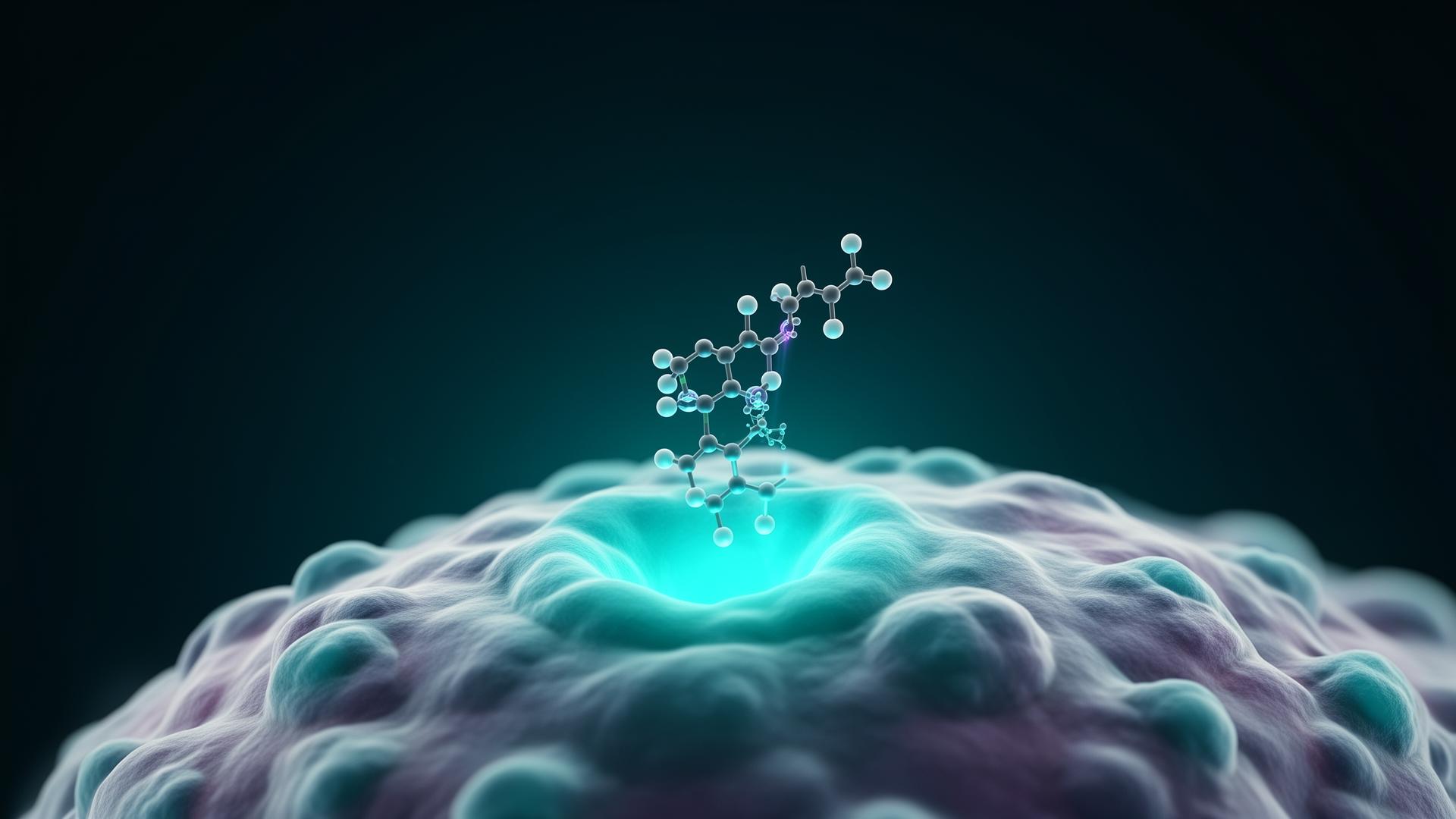
Two fundamentally different radiation profiles
Alpha and beta particles differ in mass, energy, and range — with meaningful implications for the patterns of DNA damage they produce.
Alpha particles
- Particle
- Helium nucleus (2 protons + 2 neutrons)
- Energy
- ~5–9 MeV
- Range in tissue
- ~40–100 μm (2–10 cell diameters)
- LET
- High (~80 keV/μm)
- Dominant DNA damage
- Clustered, irreparable double-strand breaks
Beta particles
- Particle
- Electron
- Energy
- ~0.5–2.3 MeV
- Range in tissue
- ~1–10 mm (~100–1000 cell diameters)
- LET
- Low (~0.2 keV/μm)
- Dominant DNA damage
- Predominantly single-strand breaks
Values are approximate ranges drawn from published radiobiology literature and are shown for educational purposes; actual values depend on the specific isotope.
Why actinium-225

Actinium-225 (Ac-225) is an alpha-emitting radionuclide with a ~9.9-day half-life that decays through a cascade releasing four alpha particles per parent atom — concentrating cytotoxic energy within a few cell diameters of the binding site.
Compared with beta-emitting radioligand therapies, alpha emitters like Ac-225 are biologically more potent per decay, with the potential to overcome hypoxia and cell-cycle dependencies that limit other forms of radiation.
- ▸High linear energy transfer (~80 keV/μm)
- ▸Short path length spares adjacent healthy tissue
- ▸~9.9-day half-life supports centralized supply
- ▸Cascade of 4 alpha decays per Ac-225 atom